Trick-or-treating covers only a small part of Halloween. The rest of the evening, and the whole weekend before it, is a house full of kids in costume with nowhere to point their energy. These Halloween scavenger hunt ideas fill that gap: twenty missions written out in full, one set for a walk around the neighborhood and one for indoors, with the teams, timing and rules that keep a group of four-year-olds, ten-year-olds, teenagers and grandparents playing the same game.
You do not need to use every mission. Pick ten to fifteen, change the details to fit your street or your living room, and you have an evening. If you would rather start from missions written for your exact party, type a sentence about it into the free Mission Generator and it gives you 10 to 20 missions to start from, with no signup.
Why a scavenger hunt suits Halloween
Most party games need everyone to be roughly the same age. A hunt does not, because a team can split the work. The smallest child spots the pumpkin, the ten-year-old reads the clue, the teenager holds the phone and the adult keeps everyone on the sidewalk. Halloween adds three things that make a hunt easier than on any other night:
- The decorations are already up. Your neighbors have done the set design. A street in late October is full of things worth finding, so you do not have to hide anything.
- Everyone is already in costume. Photo and video missions are more fun when the team is a witch, a dinosaur and a very small astronaut.
- The candy is the prize. You do not need to buy anything extra. A bowl of the good chocolate for the winning team is enough.
A hunt also gives older kids a job. The ones who feel too big for trick-or-treating are usually happy to be team captain, camera operator or the person who reads the riddles in a spooky voice.
How to set it up
Setup takes about half an hour the day before, less if you start from a generated list. Decide these five things first:
- Teams. Three to five people per team, with at least one adult or responsible teenager on each. Mix the ages on purpose; do not let all the big kids form one team. For a family of six, two teams of three works. For a party of twenty, make five teams.
- Devices. One phone per team is plenty, and it should belong to the adult or teen. Small children do not need a screen; they need to be the ones who find things.
- Boundaries. For the neighborhood version, name the streets that are in play and the ones that are not. Everyone stays with their team and crosses only at corners. For the indoor version, say which rooms are off limits.
- Time. Forty-five minutes of play is right for mixed ages. Under-sixes fade after half an hour, so put the easy, fun missions first.
- Points. Give simple finds 10 points, anything that takes teamwork 20, and keep one or two 50-point missions that every team will talk about afterwards.
In Scavvy you build the hunt on the web or in the app using four mission types: photo, video, GPS check-in and text or trivia. Teams join from an invite link or a code, and every submission lands in a live feed the whole party can see, with likes, comments and a leaderboard. On Halloween the feed is half the fun, because each team gets to watch the others' costumes and videos arrive while they are still playing. A paper list works too; the missions below are written so that you can print them and have an adult tick them off.
Neighborhood Halloween scavenger hunt ideas
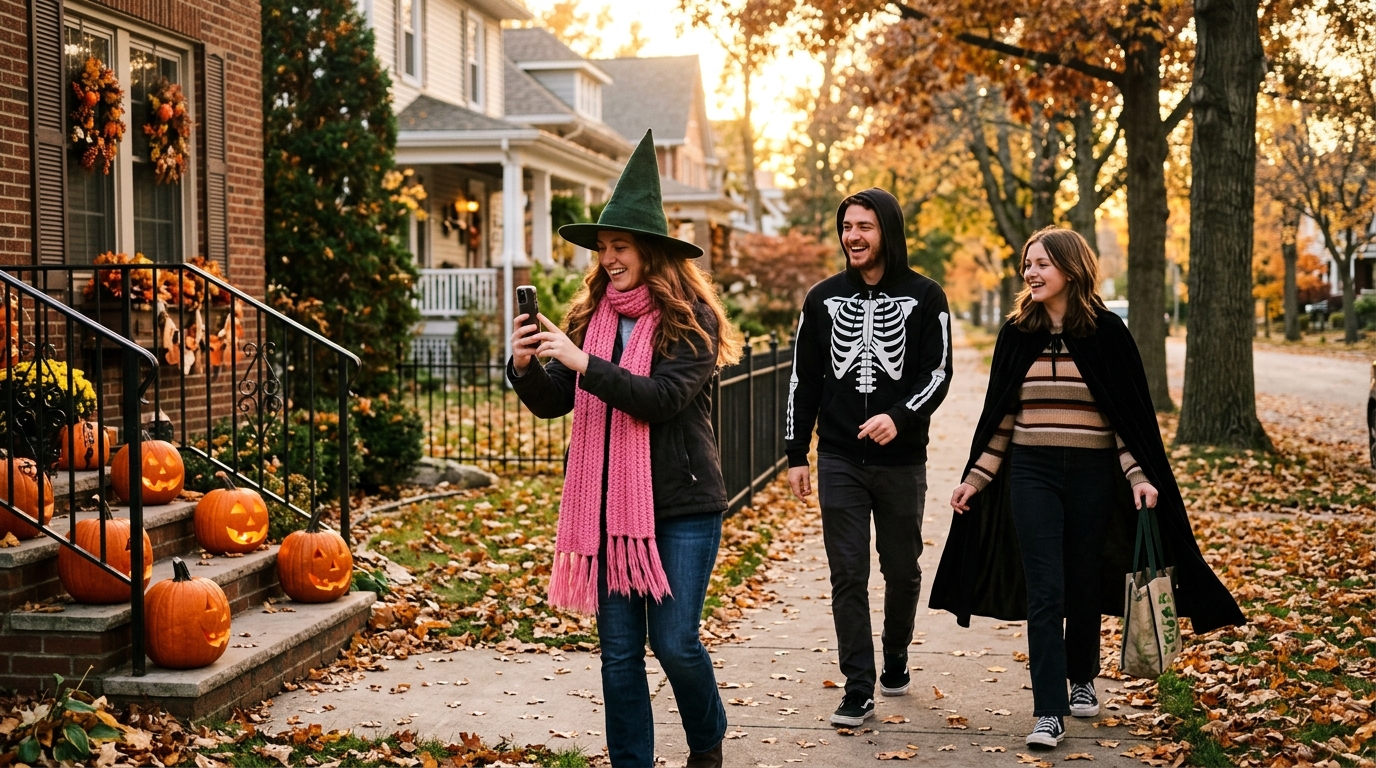
Run this one before dusk, in the hour before trick-or-treating begins, or on the weekend before Halloween when the decorations are up and the sidewalks are quiet. Every mission is done from the sidewalk. Nobody needs to knock on a door, step onto a lawn or photograph a person who is not on their team.
- photoFind a jack-o'-lantern with a scary face and one with a friendly face. Take a photo of your team copying each expression.
- photoPhotograph the tallest decoration on the street with your shortest team member standing in front of it for scale.
- triviaCount every pumpkin you can see from the sidewalk between the corner and the mailbox. Type in your number. Closest team gets the points.
- gpsCheck in at the big oak at the end of the street. This is the halfway point, so have a drink of water while you are there.
- photoFind something orange, something black and something purple that are not Halloween decorations. One photo of each.
- videoTen seconds of your whole team doing a zombie walk past a spooky yard. Stay on the sidewalk. Groaning is encouraged.
- photoPhotograph a spider web. A real one is worth double, so look at hedges and fence posts.
- photoFind a skeleton and pose your team in exactly the same position it is in.
- triviaRiddle: I have a face that glows at night, a lid on my head and no body at all. What am I? Type your answer.
- videoFifteen seconds of your youngest team member explaining their costume and what powers it has.
Change the GPS check-in to a landmark on your own street: a park gate, a particular corner, a friend's driveway where an adult is waiting with cider. A check-in in the middle of the route is also a quiet way to make sure every team walks the full loop rather than sprinting to the end.
Indoor Halloween scavenger hunt ideas
Rain, cold, a street with no sidewalks, or a party with very small children are all good reasons to stay in. The indoor version needs twenty minutes of preparation: hide a few plastic spiders, put mystery objects in a box, and turn the lights down. It works just as well for a classroom-style party in a community hall as for a living room.
- photoFive plastic spiders are hidden in the living room. Photograph each one exactly where you found it. Do not move them; other teams need them too.
- videoWrap one team member as a mummy using a single roll of toilet paper. Film the finished mummy taking three steps.
- triviaReach into the mystery box on the kitchen table without looking. There are three things inside. Type what you think they are.
- photoBuild a monster out of things from the recycling bin and the craft drawer. Photograph it and give it a name in the caption.
- videoTell a ghost story in exactly three sentences, one sentence per team member, with a flashlight under your chin.
- photoMake a shadow creature on the hallway wall with your hands and a flashlight. Photograph the shadow, not the hands.
- triviaAsk the oldest person at the party what they dressed up as when they were your age. Type their answer.
- photoFind three foods in the kitchen that could pass for witch's potion ingredients. Line them up and photograph them with their potion names.
- videoTen seconds of your team's best monster dance. Every team member has to be in the shot.
- photoTeam portrait: everyone in costume, everyone in character, nobody smiling. Last mission of the night.
The mission about the oldest person at the party is the one to keep whatever else you cut. It sends a child across the room to talk to a grandparent, and the answers in the feed are usually the best thing anyone reads all night.
A simple run of show
This timing fits a late-afternoon party that ends when trick-or-treating begins. For a weekend party with no trick-or-treating, keep the same shape and finish with food.
| Time | What happens |
|---|---|
| 4:30 | Guests arrive. Adults join the hunt from the invite link while the kids compare costumes. |
| 4:45 | Announce teams, boundaries and the three rules: stay together, stay on the sidewalk, be back when the timer ends. |
| 4:50 | Hunt begins. Forty-five minutes on the clock. |
| 5:35 | Everyone back. Put the feed on the TV and scroll through the photos and videos together while the snacks come out. |
| 5:50 | Read the leaderboard, hand over the candy bowl, and give a second prize for the funniest submission. |
| 6:00 | Trick-or-treating, with everyone already warmed up. |
The fifteen minutes of watching the feed together is worth protecting. It is when the quiet kids see their photo get a laugh from the whole room, and it gives the adults something to do other than pour drinks.
Adjusting for ages
The same hunt can stretch from preschoolers to adults if you adjust a few missions rather than writing separate lists:
- Under six: lean on finding and counting. Colors, pumpkins, spiders. Keep scary to a minimum and make sure at least half the missions can be finished in under two minutes.
- Six to ten: this is the age the hunt is built for. Add riddles, the mystery box and anything with building or dressing up.
- Teenagers: give them the video missions and the camera. Add a bonus for the most cinematic zombie walk and they will take it more seriously than you expect.
- Adults only: the same missions work for a grown-up party with harder trivia and a stricter judge. Costume-in-character missions carry the evening.
Mistakes to avoid
- Too many missions. Twelve good ones beat thirty. Teams should finish most of the list, not give up a third of the way through.
- Missions that involve strangers. Never ask kids to knock on doors, go into yards or photograph people they do not know. Everything on the neighborhood list can be done from the sidewalk, and yours should be the same.
- Playing in the dark. Run the outdoor hunt in daylight or early dusk. Photos come out better, and so does everyone's visibility to drivers. Save the flashlight missions for indoors.
- Too scary for the youngest. Spooky is fun; frightening ends the party. If a four-year-old is playing, the ghost story has three sentences and a silly ending.
- All the big kids on one team. They will win by a mile and the little ones will notice. Mix the ages and give the older ones the captain's job.
- No plan for the end. A hunt without a finish fizzles. Set a timer, call everyone back, and look at the results together.
Once you have run it once, the hunt is yours to reuse. Swap a few missions, change the check-in spot, and it is ready for next October. When you want a fresh list for a different crowd, a class party, a teen sleepover, an adults-only costume night, describe it to the Mission Generator and start from there.